
What are the top landscaping trends in Cork for 2026?
The top landscaping trends in Cork for 2026 center on high-end, climate-resilient outdoor rooms that can be enjoyed year-round. Key trends include vitrified, non-porous porcelain paving over porous natural stone; premium capped composite decking to resist wet winter rot; custom outdoor kitchens under louvred bioclimatic pergolas; engineered herringbone clay drainage grids; slatted Western Red Cedar wind barriers; and a "curated wild" meadow aesthetic mixing architectural structures with native, soft-weather Irish flora.
In this Guide:
- Introduction: The Evolution of the Irish Garden
- 1. The 'Outdoor Room' Revolution
- 2. Sustainable & Climate-Resilient Planting
- 3. Low-Maintenance Hardscaping Excellence
- 4. The 'Curated Wild' Aesthetic
- 5. Modern Fencing as a Design Statement
- 6. Case Study: Architectural Terracing in Rochestown
- 7. Landscaping Costs in Cork: A 2026 Guide
- 8. Frequently Asked Questions (People Also Ask)
Fast-Track Consultation
Looking for an immediate, obligation-free estimate for your Cork yard? Skip the read and request a quote online or call us directly for a fast-track consultation.
Introduction: The Evolution of the Irish Garden
The Irish garden has undergone a radical, architectural transformation. Gone are the days when a backyard was simply a rectangular patch of waterlogged grass enclosed by standard concrete panel walls. In 2026, homeowners across Cork—from the sweeping coastlines of Kinsale to the exclusive suburban avenues of Douglas and Blackrock—increasingly view their outdoor spaces as high-value, structural extensions of their internal living areas.
At Green Nature Garden and Landscaping, we have witnessed firsthand how a professionally designed outdoor sanctuary can not only increase property value by up to 15% but significantly elevate your lifestyle convenience. What most homeowners don’t realise is that a beautiful garden isn't a stroke of horticultural luck; it is a meticulously engineered process. In this comprehensive guide, we explore the defining landscape design trends of 2026 and outline how to craft a premium garden that is as structurally sound as it is visually arresting.

A recent bespoke garden transformation featuring modern pergolas, premium porcelain paving, and smart architectural lighting designed and executed by the Green Nature Team.
1. The 'Outdoor Room' Revolution
In Cork conditions, designing a garden strictly for "sunny days" is a recipe for a space that sits completely ignored for 350 days of the year. The defining movement of 2026 is the **"Outdoor Room."** Because our Atlantic weather is famously unpredictable, the focus has shifted entirely to architectural integration—creating spaces that bridge the gap between indoor warmth and outdoor atmospheric beauty.
A true premium outdoor room is designed with absolute technical intent to resist Cork’s wet micro-climates. Key features dominating modern designs this year include:
- Bioclimatic Pergolas: Forget basic wooden gazebos that quickly rot. Modern structures feature adjustable, motorized aluminum louvers that close tightly to seal out downpours or tilt open to capture the rare Irish sun. Integrated with dimmable LED uplights and infrared heaters, these pergolas become usable living spaces deep into chilly autumn nights.
- Bespoke Outdoor Kitchens: Outdoor entertaining has moved out of the house. Custom-built islands featuring premium gas grills, wood-fired pizza ovens, and integrated refrigeration are built using heavy-duty, weather-resistant materials like blackened structural steel, micro-cement, or polished concrete.
- Sunken Conversation Zones: By dropping a seating section by two or three steps, we create intimate, wind-protected areas centered around a sleek, modern gas fire pit. This provides an exquisite focal point and instant thermal comfort.
"Designing a modern garden without wind protection in Cork is like buying a convertible in Kinsale—looks spectacular in the showroom, but you'll rarely get to enjoy it."
2. Sustainable & Climate-Resilient Planting
Sustainability is no longer an afterthought; it dictates how we structure our botanical palettes in 2026. The modern Cork garden requires a sophisticated planting plan that can handle our heavy downpours, coastal salt winds, and mild but damp winters without requiring constant chemical intervention.
We reject generic gardening advice in favor of localized expertise. Our non-negotiable approach involves mixing hardy native Irish species with robust, structural ornamental flora to create year-round visual texture. Native specimen trees like Silver Birch (Betula pendula) and Rowan (Sorbus aucuparia) provide beautiful architectural canopy levels and support local biodiversity.
For mid-level planting beds, we combine ornamental grasses like Giant Oat Grass (Stipa gigantea) with bold, moisture-loving perennials like Hydrangea paniculata and structural ferns. This creates a multi-layered planting scheme that moves gracefully in coastal breezes, survives heavy rainfall, and maintains its structural shape even through a wet winter.

Bespoke woodland walk-way showing organic curations and multi-tiered botanical layering. Photographer: Christian Ventura
3. Low-Maintenance Hardscaping Excellence
Time is precious. Busy Cork families do not want a garden that demands hours of arduous manual labor every single weekend. Consequently, the hardscaping trends of 2026 are dominated by high-performance, low-maintenance materials that look pristine year-round and withstand our damp climate without staining, decaying, or growing unsafe layers of slick green algae.
What most homeowners don’t realise is that cheap, porous stone and untreated softwood timber are financial traps in Cork conditions. Let’s evaluate the absolute performance realities of common materials:
⌠High-Maintenance Regrets
- Imported Natural Sandstone: This stone absorbs water like a sponge. In damp, shaded Cork yards, it quickly becomes covered in black lichen and green slime, requiring intense pressure-washing that erodes mortar joints.
- Softwood Timber Decking: Natural softwood decks look beautiful for about six months. After one Irish winter, they rot, warp, and become incredibly slippery, presenting a severe safety hazard.
- Ad-Hoc DIY Drainage: Attempting to lay stone or turf directly over Cork's heavy clay subsoil without heavy-duty sub-base prep turns your yard into a muddy marsh by November.
✅ Low-Maintenance Design
- Vitrified Porcelain Paving: Fired at extreme temperatures, porcelain is completely non-porous. Moss and algae cannot grip its surface, making it exceptionally slip-resistant and cleanable with a simple sweep.
- Capped Composite Decking: Made from recycled polymers and wood fibers, capped composite decking will never rot, warp, splinter, or require annual staining. It maintains its resort-quality look for 25+ years.
- Engineered Sub-Bases: Compacting a 100mm Type 1 MOT aggregate base with deep herringbone land drains keeps the surface perfectly dry, even during severe South-West cloudbursts.
Designed properly, your hardscaping should frame the garden’s natural beauty, providing a clean, level canvas that requires nothing more than an occasional wash to remain in showroom condition.
4. The 'Curated Wild' Aesthetic
We are seeing a decisive departure from the rigid, sterile, and overly manicured garden layouts of the past decade. The dominant aesthetic of 2026 is the **"Curated Wild."** This philosophy carefully mimics the untamed beauty of natural meadows while maintaining a strong, underlying sense of architectural structure and functional layout.
To achieve this, we design wide, sweeping planting beds where structural ornamental grasses and soft flowering perennials are allowed to intermingle freely, creating dynamic movement and color changes throughout the seasons. We contrast this soft, organic planting with razor-sharp, geometric hardscaping boundaries—such as clean porcelain lines, polished concrete step rises, or steel edging. The contrast between organic freedom and architectural structure is stunningly effective.
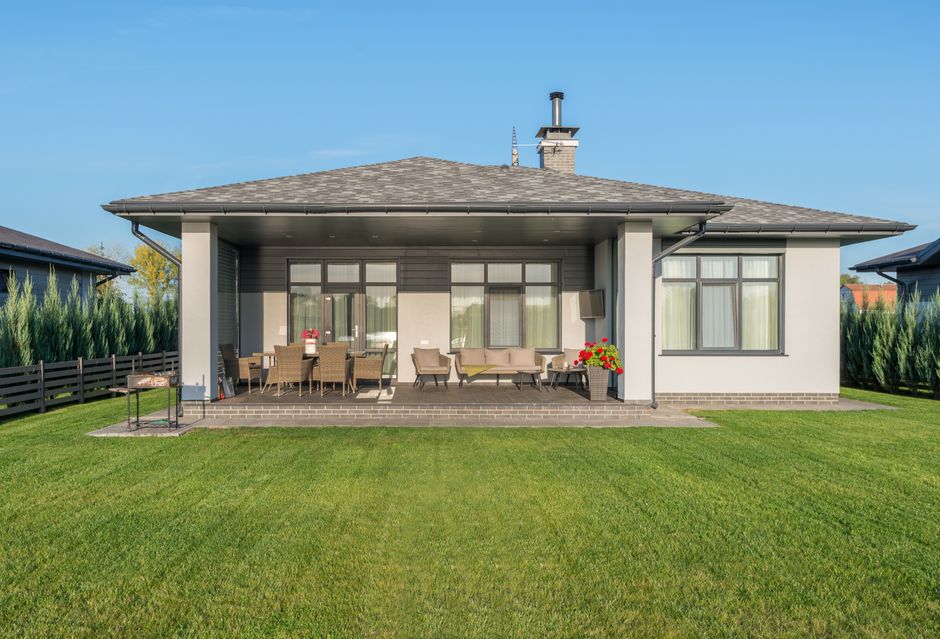
Contemporary exterior layout showcasing clean architectural lines and integrated stone caskets. Photographer: Max Vakhtbovych
5. Modern Fencing as a Design Statement
Garden boundaries are no longer treated as simple property markers; in 2026, they are treated as high-impact design statements. In Cork suburbs, where gardens are frequently exposed to harsh coastal winds, modern fencing acts as both an essential micro-climate windbreak and a key visual backdrop.
Horizontal Slatted Cedar Fencing: The slim, clean horizontal lines of cedar slatted screens create a powerful visual trick, making smaller suburban gardens feel significantly wider. The natural warmth of Western Red Cedar contrasts beautifully against dark green foliage. For those who want absolute maintenance-free performance, powder-coated dark grey aluminum slatted systems offer a premium, architectural finish that will never fade, warp, or require a coat of paint.
6. Case Study: Architectural Terracing in Rochestown
In the steep, rolling terrain of Rochestown, Cork, we were commissioned to transform a rear garden that was entirely unusable. The site had a dramatic 35-degree slope, consisting of highly compacted clay soil that remained waterlogged for most of the year. The homeowners had a beautiful modern home with expansive glass sliding doors, but their view was a muddy slope of wild brambles, sliding soil, and stagnant water.
The challenge was major: we had to retain a massive amount of earth, install a bulletproof drainage grid, and create multi-functional flat spaces that felt connected to the home’s interior architecture.
Our custom engineering solution:
- Terraced Masonry: We excavated the slope and poured steel-reinforced concrete retaining walls, which we clad in bespoke local Irish slate stone. This created three distinct, flat levels.
- The Entertaining Terrace (Level 1): Directly outside the sliding doors, we laid a 50m² large-format charcoal porcelain patio, creating a completely flush, zero-threshold transition from the living room.
- The Lawn Terrace (Level 2): We installed deep herringbone drainage pipes, backfilled with clean gravel, and laid a perfectly level, low-maintenance turf lawn framed by slatted cedar boundaries.
- The Viewpoint (Level 3): At the highest point, we constructed a composite timber deck covered by a bioclimatic pergola, capturing sweeping views over the Douglas estuary.
By splitting the dramatic slope into structured, functional terraces, we transformed a dangerous mud slide into a striking, multi-tiered outdoor sanctuary. The homeowners now enjoy a seamless, indoor-outdoor lifestyle that handles Cork’s winter rains flawlessly.
7. Landscaping Costs in Cork: A 2026 Guide
While every custom garden we design is entirely custom-engineered, understanding the investment required for professional landscaping services in Cork is vital for successful project planning. Below is a realistic guide to pricing based on current 2026 market rates in the Cork region:
| Project Scope | Average Investment Range | Key Inclusions |
|---|---|---|
| Compact / Urban Refresh | €5,000 - €12,000 | Site clearance, sandstone/limestone patio, new turf lawn, basic timber fencing, border planting. |
| Complete Medium Makeover | €12,000 - €25,000 | Bespoke garden design, premium porcelain paving, slatted cedar fencing screens, advanced clay drainage, lawn laying, smart uplighting. |
| Architectural Garden Escape | €25,000 - €60,000+ | Full landscape architecture, reinforced concrete retaining masonry, high-end composite decking, custom pergolas, outdoor kitchens, specimen planting. |
*Note: Estimates include VAT, expert site preparation, commercial waste disposal fees, and all structural materials. Complex sloping sites requiring heavy retaining walls will sit at the higher end of these brackets.
8. Frequently Asked Questions (People Also Ask)
The vast majority of medium-sized garden makeovers in Cork take between **2 to 4 weeks** to complete. However, larger, multi-level structural projects involving extensive retaining masonry, heavy machinery excavation, or outdoor kitchen installations can take between **5 to 8 weeks**. At Green Nature, we provide detailed, day-by-day project schedules to minimize disruption and ensure smooth execution.
While hardscaping tasks (like laying porcelain patios, building retaining walls, and installing slatted fencing) can be executed **year-round in Cork's mild climate**, the absolute best window to start a full garden transformation is from **early Spring (March/April) through to mid-Autumn (October)**. This provides optimal soil temperatures for new grass seed germination, turf laying, and the successful establishment of new plant roots.
Yes, **capped composite decking is infinitely superior** to traditional timber decking in Ireland. Standard softwoods absorb moisture and rot quickly under Cork’s heavy annual rainfall, becoming dangerously slick with green algae. Premium composite decking is engineered from polymer-wrapped recycled wood fibers, meaning it **never warps, splinters, rots, or requires sanding and staining**, remaining completely slip-resistant and pristine for decades.
In Cork conditions, **we strongly recommend vitrified porcelain paving** over natural sandstone. Sandstone is a highly porous natural rock that acts like a sponge, absorbing water and locking in dirt. This makes it highly prone to black lichen stains and green algae growth in damp weather. Vitrified porcelain is fired at extreme heat to be completely non-porous, meaning it **never absorbs water, is highly stain-resistant, slip-resistant, and stays pristine** with basic washing.
Ready to Transform Your Outdoor Space?
Contact Green Nature today to schedule a bespoke landscape consultation. Let us bring architectural structure, proper drainage, and botanical beauty to your Cork home.

Written by the Green Nature Design Team
Specialists in Irish landscape design, structural masonry, and high-performance drainage. Crafting enduring outdoor sanctuaries across Cork City and County for over 15 years.
Recommended Reads
 Pricing Guides
Landscaping Cost Cork: 2026 Price Guide & Roadmap
Get the ultimate cost breakdown for patios, composite decking, fresh turf lawns, and complete garden makeovers...
Read Full Guide Design Trends
Complete Garden Renovation Cork: Step-by-Step
The ultimate roadmap for a full garden makeover. Explore design planning, excavation, gravel drainage, and layout...
Read Full Guide Design Trends
Patio Installation Cork: Porcelain vs Sandstone vs Paving
An expert comparison of paving materials for Cork's wet climate. Explore cost, drainage, and slip-resistance...
Read Full Guide