
How much does garden landscaping cost in Cork?
In 2026, the average cost of garden landscaping in Cork ranges from €3,000 to €8,000 for a small yard cleanup/refresh, €8,000 to €20,000 for a standard medium-sized garden makeover (incorporating a porcelain patio and new lawn), and upwards of €20,000 to €50,000+ for premium structural transformations involving retaining walls, bespoke slatted fencing, and full-scale outdoor living rooms. Hourly garden maintenance rates generally range between €35 and €60 per hour.
Table of Contents
- 1. The Cork Landscaping Market in 2026
- 2. Average Costs by Garden Size
- 3. Component Pricing: Patios, Fencing, Turf, & Maintenance
- 4. The "Cork Climate Tax": Why Cheap Materials Cost Double
- 5. Key Factors that Influence Your Quote
- 6. Case Study: A Wet Douglas Backyard Turned Premium Sanctuary
- 7. The Strategic Phase-by-Phase Investment Roadmap
- 8. Frequently Asked Questions (People Also Ask)
Fast-Track Consultation
Looking for an immediate, obligation-free estimate for your Cork yard? Skip the read and request a quote online or call us directly for a fast-track consultation.
1. The Cork Landscaping Market in 2026
The Irish garden has evolved radically. Gone are the days when a backyard was simply a rectangular patch of soggy grass enclosed by standard concrete panels. Today, Cork homeowners—from the seaside retreats of Kinsale to the leafy suburban avenues of Douglas and Blackrock—increasingly view their outdoor spaces as high-value, architectural extensions of their homes.
However, planning a premium garden redesign requires clear financial transparency. Unlike simple interior decorating, structural landscaping involves extensive groundwork, drainage correction, raw materials sourcing, and skilled structural trades (masons, timber builders, horticulturists). In the Cork region, the mild, damp weather means that materials must be chosen with absolute technical intent to resist waterlogging, moss growth, and rot. Let’s dissect the real investment required to transform your yard in 2026.
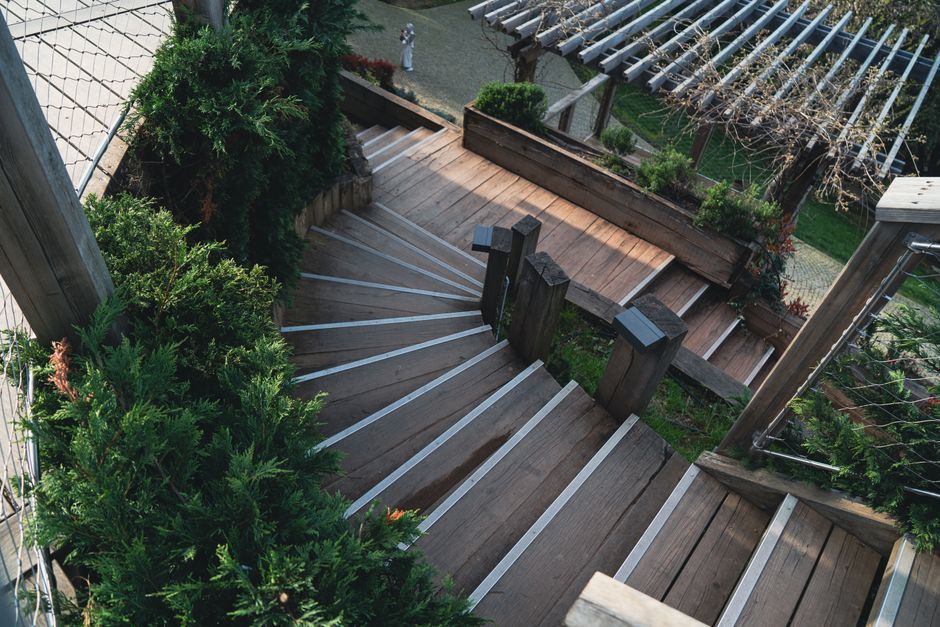
Bespoke garden design featuring structured levels, custom timber steps, and lush, native Irish border planting. Photographer: Emre Simsek
2. Average Costs by Garden Size
To help you establish a realistic baseline, we have categorized complete garden transformations by scope and scale. These ranges reflect 2026 market realities in Cork and include VAT, high-grade professional site prep, and waste disposal.
Small Garden / Front Yard Refresh: €3,000 – €8,000
Ideal for compact urban courtyards or front gardens. Typically covers general clearance, laying a small natural lawn or artificial grass pad, structural timber fencing, a modest concrete or limestone patio, and boundary border planting.
Medium Garden Transformation: €8,000 – €20,000
The standard benchmark for most semi-detached and detached homes in Cork. This level of investment accommodates a complete redesign, featuring a premium large-format porcelain patio, custom timber slatted fencing, high-grade sod turf laying with proper sub-base prep, atmospheric uplighting, and a complete horticultural planting scheme.
Large / Premium Garden Escape: €20,000 – €50,000+
Bespoke landscape architecture for estate-scale gardens or complex sloping sites. Includes heavy machinery excavation, engineered retaining concrete walls, hand-crafted Irish dry-stone walling, high-end composite decking, high-end garden lighting plans, outdoor kitchens, bioclimatic pergolas, and architectural specimen planting.
3. Component Pricing: Patios, Fencing, Turf, & Maintenance
If you prefer to tackle individual sections or upgrade existing components, here is the granular breakdown of pricing per square metre or linear metre in the Cork region:
| Landscaping Component | Standard Specification | Bespoke / Premium Option |
|---|---|---|
| Patio & Paving (per m²) | €60 - €95 (Standard Sandstone / Limestone) |
€110 - €185+ (porcelain patio installation in Cork) |
| Garden Decking (per m²) | €90 - €140 (Treated Softwood / Larch) |
€180 - €290+ (Premium Low-Maintenance Composite) |
| Fencing Installation (per linear m) | €50 - €85 (Standard Panel / Closeboard) |
€110 - €195+ (Bespoke Slatted Cedar / Dark Grey Aluminum) |
| New Lawn Installation (per m²) | €20 - €35 (Fresh Irish Turf Sod & Soil Prep) |
€55 - €85+ (high-density artificial grass Cork) |
| Garden Maintenance (per hour) | €35 - €45 (Basic Lawn Mowing & Weeding) |
€50 - €65+ (Specialist Hedge Reductions & Tree Surgery) |

A clean, modern patio design featuring low-maintenance porcelain paving and structured planting. Photographer: Princess ara Versabal
4. The "Cork Climate Tax": Why Cheap Materials Cost Double
Here is what most homeowners—and generic internet cost guides—don’t realise: Cork has its own unique environmental tax. With average annual rainfall exceeding 1,200mm and persistent coastal dampness, building a garden in Cork requires distinct technical material choices.
If you choose cheap, porous materials to save a few Euros upfront, you are essentially setting a timer for when you will have to pay to replace them. Let's look at the direct trade-offs in our local conditions:
⌠What Fails in Cork Conditions
- Softwood Timber Decking: Natural softwood decks look beautiful—for about six months in Cork. After one wet Irish winter, the timber absorbs moisture, swells, rots, and becomes dangerously slick with green algae. You will spend hours power-washing and staining it every single spring.
- Porous Natural Sandstone: Standard imported sandstone absorbs water like a sponge. In shaded Cork backyards, this constant dampness invites massive black lichen and green moss colony growth. The stone will require intense chemical treatment and heavy pressure washing, which eventually erodes the joints.
- Poorly Prepared Sod Turf: Simply rolling out turf grass over Cork’s heavy clay subsoil without extensive gravel drainage layers results in a waterlogged, muddy swamp by mid-November.
✅ The Smarter Long-Term Cork Choices
- Premium Capped Composite Decking: Made from recycled polymers and wood fibres, it does not absorb moisture. It will not warp, rot, splinter, or require annual staining, keeping its resort-style look for 25+ years with zero fuss.
- Non-Porous Porcelain Paving: Vitrified porcelain is fired at extreme temperatures to become completely non-porous. Algae and moss cannot grip the surface, meaning your patio stays "showroom new" year-round. It is slip-resistant and requires nothing more than a light wash.
- Smart Sub-Base Prep: Installing a 100mm compacted MOT Type 1 aggregate base with deep herringbone land drains. This ensures that even during heavy South-West cloudbursts, your garden drains perfectly.
Professional Cork Drainage Alert
Avoid structural failures, rotting timbers, and waterlogged turf in Cork's heavy clay soil. Let our experts design and build it correctly the first time.
Request a professional drainage quote →5. Key Factors that Influence Your Quote
Every garden is a unique micro-ecosystem, and no two quotes are identical. The main factors that shift a quote include:
1. Site Accessibility
This is a major variable in older terraced estates in Cork City or tight suburban developments. If materials and heavy excavation machinery must be brought through a narrow side gate, or worse, carried manually through your hallway, labour time (and cost) increases exponentially. If we can fit a micro-digger, the work progresses significantly faster.
2. Ground Conditions & Levelling
Cork is famously hilly. If your property is built on a slope, significant retaining work is required. Pouring reinforced concrete retaining walls, installing structural block steps, and handling major soil export costs are the most expensive parts of a landscaping project. Furthermore, Cork’s clay soil retains heavy moisture, requiring a deep, professionally engineered drainage grid.
3. Waste Disposal & Skip Hire
Homeowners often underestimate the sheer weight of excavated soil and old concrete. Disposing of soil, old paving, and overgrown vegetation carries significant commercial disposal fees at Cork recycling stations, which must be accounted for in the initial quote.
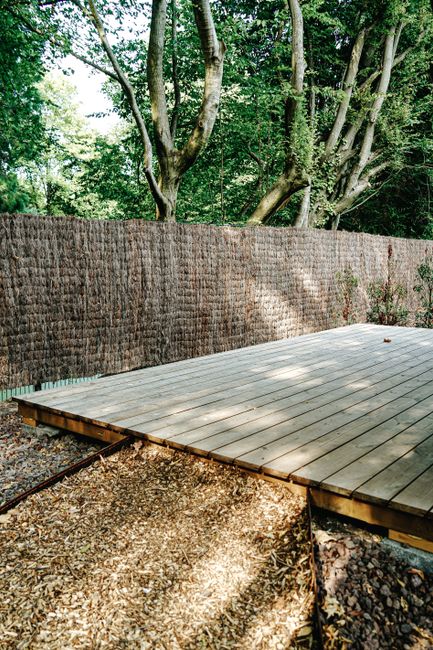
Bespoke composite decking seamlessly integrated into a wooded residential perimeter, creating a resilient, low-maintenance retreat. Photographer: Marion Batteur
6. Case Study: A Wet Douglas Backyard Turned Premium Sanctuary
In Douglas, we worked with a family whose garden was essentially unusable for nine months of the year. Their back lawn was built on heavy clay and, due to poor initial design by their housing developer, water collected in a huge muddy pool directly outside their patio doors. Their two golden retrievers would regularly track mud throughout the house, and their old timber deck had become so rotten and slippery that it was a literal safety hazard.
The family wanted a low-maintenance, architectural "outdoor room" where they could entertain friends and let the dogs out without the constant mud-fest.
Our approach was complete structural restoration:
- Excavation & Drainage: We excavated the top 200mm of waterlogged clay, installed a deep herringbone land drainage system linked to a soakaway, and laid a solid compacted gravel sub-base.
- Porcelain Patio: We laid a 45m² sleek, large-format grey porcelain patio, creating a seamless transition from the home’s sliding glass doors.
- Bespoke Fencing: We built premium horizontal slatted Western Red Cedar fencing along the perimeter to block local winds and create a warm, resort-quality backdrop.
- Synthetic Grass: We installed a 50m² high-density, pet-friendly artificial grass lawn, utilizing a granite-dust sub-base for maximum drainage and durability.
The result? A completely transformed, year-round space that added massive lifestyle convenience and immediate property value. The family went from dreading their backyard to dining outdoors nearly every weekend.
7. The Strategic Phase-by-Phase Investment Roadmap
If a €20,000 garden transformation is not in your immediate budget, don't make the mistake of choosing cheap, temporary materials. Instead, **phase your project strategically over 2–3 years** to protect your cash flow and ensure you only build once, and build right.
Phase 1 (Year 1): Groundwork, Drainage, & Hardscaping (The Structural Shell)
Spend your initial budget on the heavy, messy, and structural tasks. This includes land clearance, leveling, installing sub-surface drainage, building retaining walls, and laying your main porcelain patio or stone masonry. These jobs require heavy machinery and are highly disruptive—do them first so you don't destroy your new lawn later.
Phase 2 (Year 2): Timber Work, Decking, & Boundary Fencing
Once your heavy groundwork is stable and fully drained, focus on boundaries and elevated spaces. Install your composite decking, put up your architectural slatted timber fences, and build custom pergolas or raised block beds.
Phase 3 (Year 3): Turf Sod, Smart Lighting, & Curation Planting
Complete the transformation with the final decorative touches. Lay down your fresh sod or artificial turf, set up your low-voltage ambient uplighting, and plant your curated botanical beds. Planting and lighting are highly satisfying, non-disruptive finishing details that bring the entire architecture to life.
8. Frequently Asked Questions (People Also Ask)
In 2026, a professional landscape gardener in Ireland typically charges between €250 and €350 per day for general labour. However, for specialized services involving skilled trades (such as stone masons, carpenters, or design consultants) and equipment hire (micro-diggers, dumpers), daily rates generally range between €400 and €650+ per day. It is always safer to request a fixed-price project quote rather than relying on daily rates, as ground conditions can unpredictably extend project times.
The most expensive part of any landscaping project is **ground preparation and structural engineering**. This includes heavy excavation, soil removal, drainage correction, and the construction of reinforced retaining walls or steps on sloped gardens. Because this work involves expensive heavy machinery, massive volumes of stone aggregate, and intensive skilled labour, it often consumes up to 40% to 50% of the entire project budget before any finishing materials (like porcelain paving or plants) are even purchased.
Absolutely. Phasing is the smartest way to budget for a premium garden without compromising on material quality. A typical roadmap focuses on **groundwork, drainage, and structural hardscaping in Year 1**, followed by **timber decking and boundary fencing in Year 2**, and finishing with **turf laying, lighting, and botanical planting in Year 3**. This prevents you from spending money on cheap softwood or porous stone that would only need to be ripped out and replaced a few years later.
For the vast majority of domestic landscaping projects in Cork, **you do not need planning permission**. Standard patios, lawn installations, raised beds, and standard garden fences (up to 2 metres in height at the rear, or 1.2 metres in the front) are considered exempted development. However, you will need planning permission if you intend to build exceptionally high retaining walls, block natural water drainage patterns that affect neighboring properties, or construct large permanent structures (like closed garages) that exceed exempted sizes.
A professionally landscaped garden can add between 5% and 15% to the overall resale value of an Irish property. In highly competitive Cork suburbs like Douglas, Kinsale, or Blackrock, a premium, low-maintenance outdoor room acts as a massive selling point, significantly reducing the time the property sits on the market. Buyers are highly motivated by spaces that feel immediately usable and structurally sound, saving them the stress of managing drainage or paving issues post-purchase.
Ready to Invest in Your Dream Cork Garden?
Contact Green Nature today to schedule a bespoke consultation in Cork. We bring architectural structure, proper drainage, and botanical artistry to your doorstep.

Written by the Green Nature Design Team
Specialists in Irish landscape design, structural masonry, and high-performance drainage. Crafting enduring outdoor sanctuaries across Cork City and County for over 15 years.
Recommended Reads
 Pricing Guides
How Much Does a Gardener Cost in Cork? (2026 Rates)
Get the complete pricing guide for hedge trimming, grass cutting, and bi-weekly garden maintenance contracts in Cork...
Read Full Guide Design Trends
Complete Garden Renovation Cork: Step-by-Step
The ultimate roadmap for a full garden makeover. Explore design planning, excavation, gravel drainage, and layout...
Read Full Guide
Design Trends
Ultimate Guide to Landscaping in Cork (2026 Trends)
Discover how to transform your Irish garden with the latest in sustainable design, outdoor rooms, and hardscaping...
Read Full Guide